
Agave Syrup vs Sugar: Which Is Healthier? A Science-Backed Comparison
Agave syrup is generally a healthier choice than white sugar for most everyday uses. It has a glycemic index of around 17 compared to sugar's 65, is about 1.4 times sweeter (so you use less), and is minimally processed with just one ingredient. However, agave is high in fructose, so it's not unlimited. The honest answer: use agave instead of sugar, in moderation, and you'll get most of the benefit without giving up the things you love.
That's the short version. Now let's dig into what actually matters, because almost every "agave vs sugar" article online either dramatically oversells agave or dismisses it as marketing hype. The truth is somewhere in between, and it depends on what you're trying to achieve.
The numbers, side by side
Here's the comparison most people are looking for, with no rounding tricks:
| Metric | Agave Syrup | White Sugar |
|---|---|---|
| Glycemic Index | ~17 | 65 |
| Sweetness vs sugar | 1.4x | 1x baseline |
| Calories per tablespoon | ~60 kcal | ~48 kcal |
| Carbohydrates per tbsp | ~16 g | ~12.5 g |
| Fructose content | 70 to 90% | 50% |
| Processing | Minimal (heated sap) | Heavily refined |
| Dissolves in cold | Yes | No |
| Vegan | Yes | Yes |
| Gluten-free | Yes | Yes |
A few of these numbers need explanation, because the marketing on both sides distorts them.
Why glycemic index matters more than calories
If you take one thing from this article, take this: the calorie comparison between agave and sugar is a red herring. The real difference is what those calories do to your blood sugar.
Glycemic index measures how quickly a food raises your blood glucose after you eat it. Pure glucose is set at 100, and everything else is measured against that. Sugar (sucrose) clocks in at 65, which is considered moderate-to-high. Agave sits at around 17, which is genuinely low.
Why? Sugar is half glucose and half fructose. The glucose half hits your bloodstream fast and triggers an insulin response. Agave is mostly fructose (around 70 to 90 percent depending on the producer). Fructose is processed almost entirely by the liver and doesn't trigger the same blood sugar spike.
In practical terms, this means:
- You don't get the 10am energy crash after sweetening your morning coffee with agave the way you do with sugar
- Diabetics and prediabetics can include agave with less impact on their daily glucose readings (though always consult your doctor)
- The afternoon snack craving that hits an hour after a sugary meal is reduced
A 2010 study by Wolever and colleagues in the Journal of Nutrition compared blood glucose responses in type 2 diabetics consuming agave versus sucrose. The agave group showed significantly smaller blood sugar spikes. That's not a magical claim. It's a measurable, replicable result.
The fructose conversation we have to have
If agave is so much better than sugar, why isn't every doctor recommending it?
Because of the fructose. Sugar is roughly 50 percent fructose. Agave is 70 to 90 percent. While fructose doesn't spike blood sugar, it has to be processed by the liver, and there's emerging research suggesting that very high fructose diets may contribute to non-alcoholic fatty liver disease and insulin resistance over time.
Here's the honest framing: this concern applies to extreme consumption. The average person sweetening their daily coffee, occasional baked goods, and weekend cocktails with agave is consuming a small fraction of the fructose load required to cause these issues. The bigger fructose problem in most diets is high-fructose corn syrup in processed foods and sugary drinks consumed in industrial quantities.
The takeaway: agave is healthier than sugar for normal sweetener use. It's not a free pass to use four times as much. The "use less" principle applies to all sweeteners.
Why 1.4 times sweeter is a bigger deal than it sounds
Agave is roughly 1.4 times sweeter than sugar. This sounds like a minor detail, but it has real consequences.
Most recipes are written assuming you'll use sugar. If you swap in the same amount of agave, the result will be too sweet. The correct conversion is roughly three-quarters of a cup of agave for every cup of sugar.
In daily use, this means you're consuming about 30 percent fewer calories and 30 percent less fructose to achieve the same level of sweetness. Calories aren't the main reason to switch to agave, but they're a side benefit.
Calorie math: One tablespoon of agave is about 60 kcal versus 48 kcal for one tablespoon of sugar. But you only need three-quarters of a tablespoon of agave to match one tablespoon of sugar in sweetness, which puts you at about 45 kcal. Slightly fewer calories, much lower glycemic impact, same sweetness.
What about honey? Why not just use that?
Honey is the closest comparison point for Indian consumers because most of us were raised hearing that honey is the "healthy" alternative to sugar. Here's how honey fits into this conversation:
Honey has a glycemic index of around 58. Better than sugar's 65, but much higher than agave's 17.
Honey is not vegan. For India's growing vegan population, this matters.
Honey has flavour. Strong floral notes that work beautifully in some applications and clash badly in others. Honey in a margarita is a disaster. Honey in masala chai is divine.
Honey doesn't dissolve in cold drinks. You have to mix it with hot water first to make honey syrup, then cool it down.
Honey is significantly more expensive in premium grades than agave. A good 250g honey from brands like Last Forest or Under The Mango Tree runs 400 to 600 rupees. A 400ml Fructo agave bottle is 529 rupees.
For warm beverages and traditional Indian uses, honey often wins on flavour. For everything else, agave is more versatile and has a lower glycemic impact.
Where sugar still wins (yes, really)
We're not going to pretend agave is better than sugar at everything. There are specific cases where sugar is the right choice:
Caramelisation. Sugar caramelises at around 170°C and creates that nutty, deep brown flavour you find in crème brûlée, caramel sauce, and tadka pan sugar finishes. Agave doesn't caramelise the same way. For these applications, use sugar.
Crisp baked goods. Cookies, biscotti, and anything where you want a crisp, dry texture rely on sugar's crystalline structure. Agave is a liquid, which makes baked goods moister and softer. Great for cake, less great for shortbread.
Cost at very high volumes. If you're feeding a large family and your monthly sweetener spend is a real budget concern, sugar at 50 rupees per kg is unmatched on pure cost per gram. Most premium sweeteners are 10 to 20 times more expensive.
Cultural recipes. Some Indian sweets like jalebi, gulab jamun, and rasmalai depend on sugar syrup at specific concentrations. Replacing it with agave changes the texture and behaviour. Use sugar for these.
When should you choose agave over sugar?
A simple rule: use agave for anything where you'd notice the glycemic impact, the convenience, or the cleaner taste, and use sugar where you specifically need its physical properties.
Choose agave for:
- Daily coffee, tea, and chai
- Smoothies and protein shakes
- Cold beverages (iced coffee, lemonade, cold brew)
- Cocktails and mocktails (this is non-negotiable)
- Salad dressings and marinades
- Yogurt, oats, and breakfast bowls
- Moist cakes, banana bread, muffins
- Anyone managing blood sugar
Choose sugar for:
- Caramel sauces and brûlée
- Crisp cookies, biscotti, meringues
- Traditional Indian sweets requiring sugar syrup
- Very high-volume baking on a tight budget
What about other sweeteners? Where does agave rank?
Quick reality check on the other options people consider:
Stevia is zero calorie and zero glycemic, which sounds perfect. The downside is the slightly bitter, almost metallic aftertaste, especially at higher concentrations. It also doesn't have the syrup-like consistency that cocktails and baking need. For pure calorie reduction, stevia wins. For everyday cooking and drinking, agave is more pleasant.
Coconut sugar has a glycemic index of around 35, which is lower than sugar but higher than agave. It has a mild caramel flavour and works well in baking. It doesn't dissolve in cold liquids, which limits its use in cocktails and iced drinks.
Date syrup is delicious but very strongly flavoured. Its glycemic index is around 50, similar to honey. Great for Indian sweets and certain baked goods. Not a daily coffee sweetener.
Jaggery is traditional and unrefined, which is great. But its glycemic index is around 84, even higher than refined sugar. The "natural is better" instinct doesn't apply here when it comes to blood sugar.
Monk fruit has a GI of zero and is calorie-free. It's the keto crowd's favourite. Two problems for Indian consumers: it's hard to find, and it's very expensive (often 1,200 rupees for a small bottle of liquid monk fruit).
If you rank all of these by GI, agave is one of the lowest naturally derived liquid sweeteners available in India.
The cost-per-use truth
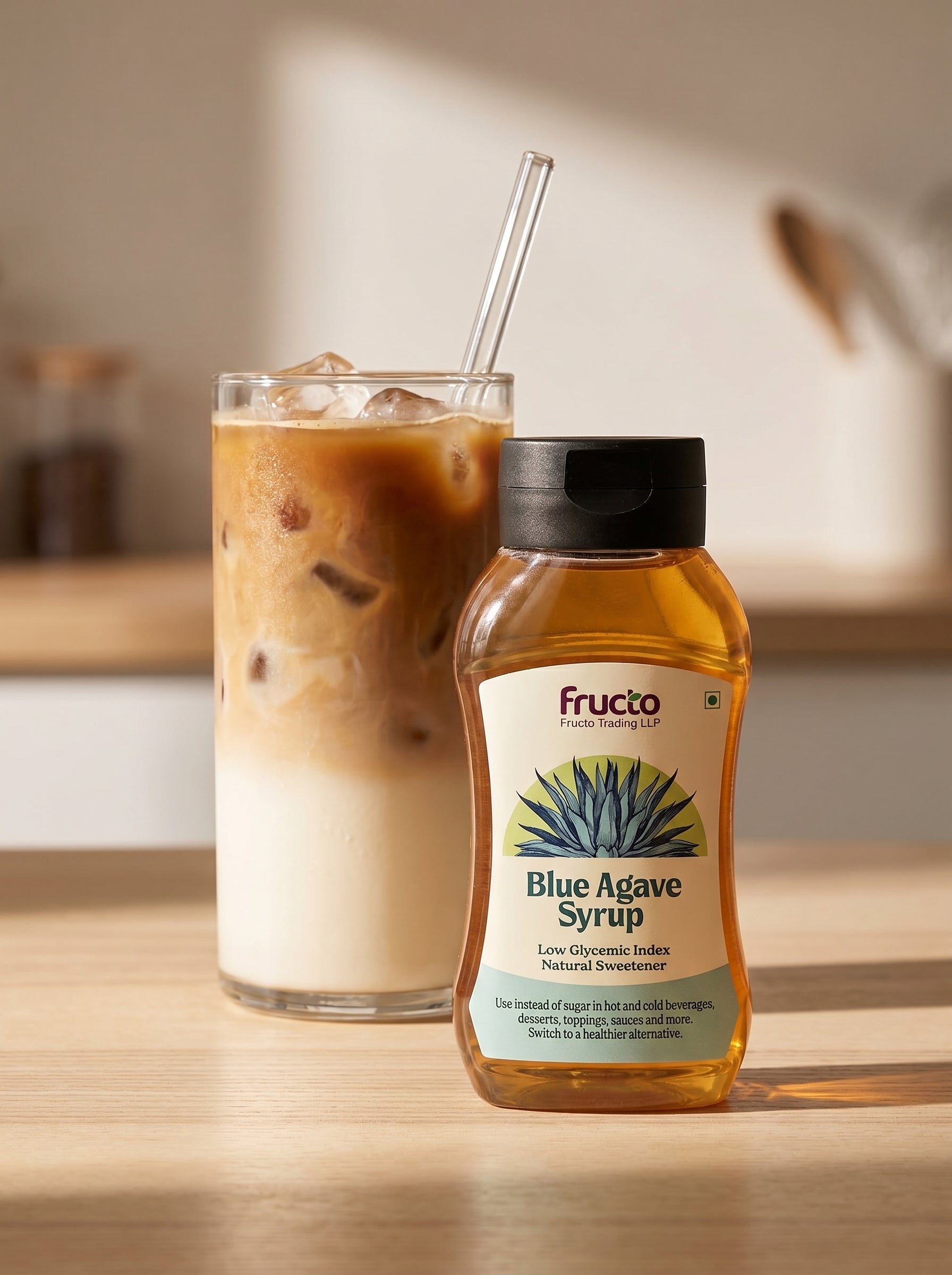
A 400ml bottle of Fructo Blue Agave Syrup is 529 rupees. That's about ₹1.32 per millilitre.
A daily coffee drinker uses one teaspoon (5ml) of agave per cup. That's about 6.60 rupees per cup of sweetener.
White sugar in a 1kg pack at around 50 rupees works out to roughly 25 paise for the same teaspoon by weight.
So agave is about 25 times more expensive per use than sugar. But here's the framing that matters: a single cup of premium coffee at a café costs 200 to 400 rupees. A premium tea bag costs 30 to 50 rupees. The sweetener is the cheapest part of the equation in any premium beverage habit. If you're already investing in good coffee or tea, the agave premium is genuinely small in context.
So which is healthier, in one sentence?
Agave syrup is healthier than sugar for everyday use because of its much lower glycemic index, but the difference disappears if you treat it as an unlimited license. Use it the way you'd use any quality ingredient: in moderation, with intention, and as part of a generally balanced diet.
Frequently Asked Questions
Is agave less fattening than sugar? Per tablespoon, agave has slightly more calories than sugar (60 vs 48). But because agave is 1.4x sweeter, you use less, so the practical calorie difference is small. The main benefit isn't weight loss, it's the lower blood sugar response.
Will agave help me lose weight? Switching sweeteners alone is rarely a weight loss strategy. The lower glycemic impact may reduce sugar cravings and energy crashes, which can indirectly help. But agave is still a sugar, just a more stable one.
Is agave safe for kids? For children over one year old, agave is generally safe in moderation. For infants under one, no sweetener (agave, honey, or sugar) is typically recommended.
Can I use agave to replace sugar in tea? Yes, and it dissolves at any temperature unlike sugar, which sometimes settles at the bottom of cold drinks. One teaspoon of agave equals roughly 1.4 teaspoons of sugar in sweetness.
Does agave raise insulin? Agave's low glycemic index means it produces a much smaller insulin response than sugar. For diabetics, this is meaningful but should be discussed with your doctor.
Is brown sugar healthier than agave? No. Brown sugar is essentially white sugar with molasses added back. Its glycemic index is the same as white sugar (65), so it has none of agave's blood sugar advantages.
The bottom line
If you're making the switch to lower-glycemic sweetening for everyday use, agave is one of the best options available in India today. It's not a miracle ingredient, and we'd rather you understand its real strengths and real limitations than feel cheated later. Use it in moderation, choose it for cold drinks and daily beverages, and keep regular sugar around for the specific applications where it still wins.
Ready to try it? Our 400ml bottle at ₹529 is the perfect way to bring agave into your kitchen.
Try Fructo Blue Agave Syrup | Read: 7 Best Natural Sugar Substitutes in India
0 comments